Amazon.com Q3 results – sales up 44% to $10.88 Billion, Net income down 73% to $63 million

Amazon.com has announced financial results for its third quarter ended September 30, 2011.

Highlights

  • Net sales increased 44% to $10.88 billion in the third quarter, compared with $7.56 billion in third quarter 2010. Excluding the $371 million favourable impact from year-over-year changes in foreign exchange rates throughout the quarter, net sales would have grown 39% compared with third quarter 2010.
  • Operating income was $79 million in the third quarter, compared with $268 million in third quarter 2010. The favourable impact from year-over-year changes in foreign exchange rates throughout the quarter on operating income was $14 million.
  • Net income decreased 73% to $63 million in the third quarter, or $0.14 per diluted share, compared with net income of $231 million, or $0.51 per diluted share, in third quarter 2010.
  • Operating cash flow increased 19% to $3.11 billion for the trailing twelve months, compared with $2.62billion for the trailing twelve months ended September 30, 2010. 
  • Free cash flow decreased 17% to $1.53 billion for the trailing twelve months, compared with $1.83 billion for the trailing twelve months ended September 30, 2010.
  • Common shares outstanding plus shares underlying stock-based awards totaled 469 million on September 30, 2011, compared with 465 million a year ago.

“September 28th was the biggest order day ever for Kindle, even bigger than previous holiday peak days – we introduced Kindle Fire for $199, Kindle Touch 3G for $149, Kindle Touch for $99, and our all new Kindle for only $79,” said Jeff Bezos, founder and CEO of Amazon.com. “In the three weeks since launch, orders for electronic ink Kindles are double the previous launch. And based on what we’re seeing with Kindle Fire pre-orders, we’re increasing capacity and building millions more than we’d already planned.”


Fourth quarter 2011 guidance from Amazon

The following forward-looking statements reflect Amazon.com’s expectations as of October 25, 2011. Our results are inherently unpredictable and may be materially affected by many factors, such as fluctuations in foreign exchange rates, changes in global economic conditions and consumer spending, world events, the rate of growth of the Internet and online commerce and the various factors detailed below.

  • Net sales are expected to be between $16.45 billion and $18.65 billion, or to grow between 27% and 44% compared with fourth quarter 2010.
  • Operating income (loss) is expected to be between $(200) million and $250 million, or between 142% decline and 47% decline compared with fourth quarter 2010.
  • This guidance includes approximately $200 million for stock-based compensation and amortization of intangible assets, and it assumes, among other things, that no additional business acquisitions or investments are concluded and that there are no further revisions to stock-based compensation estimates.

USA, Seattle, WA

Related articles:

DMGT trading update September 2011


DMGT trading update to September 2011

Year end is October 2, 2011

The trading update covers the eleven month period to the end of August 2011

Summary

Revenue up 1% on last year, up 2% on an underlying basis

B2B businesses revenues up 9%

Consumer businesses revenues down 3% on an underlying basis

Forecast for the year at the lower end of the range of market expectations~

BUSINESS TO BUSINESS

Revenues from the group’s B2B operations for the period were 8% higher than for the corresponding period last year, with an underlying increase of 9%.

At a divisional level, Risk Management Solutions’ revenues grew by 4%, an underlying increase of 11%, reflecting continued growth from RMS’s core modelling business.

At dmg information, reported revenues grew by 1%. The underlying revenue increase was 5% with good growth from our companies in the property, education and energy information markets.

At dmg events, reported revenues grew by 20% including the impact of this year’s additional biennial show. The underlying revenue increase was 14%. This includes dmg event’s largest recent event, the summer New York International Gift Fair in August, part of GLM, the sale of which is expected to complete in late September.

B2B revenues include those of Euromoney Institutional Investor, which released its trading update on 23rd September, reporting that total revenues for the full year are expected to show a headline increase of approximately 10%. Recent trading has shown a slowing in the rate of growth of advertising and event sponsorship sales. In contrast, delegate bookings for events and training courses have held up well, and subscriptions revenues have continued to grow at similar rates to the third quarter.

Euromoney has reported that it may achieve the profit target under its capital appreciation plan (CAP 2010) a year earlier than expected. This would give rise to an additional accelerated long-term incentive expense of £6.6 million under IFRS2 which is not reflected in the current estimates for the full year result.

CONSUMER MEDIA

Underlying revenues from A&N Media were 3% lower than for the corresponding period last year and 4% lower on a reported basis. A&N Media has continued to focus on operational efficiency. However, weaker advertising revenues, combined with the high cost of newsprint, will lead to significantly lower profits for the full year compared to last year.

Planning consent has recently been granted for the construction of Harmsworth Printing’s new printing plant in Thurrock. The group plans to acquire the freehold of the site and for the first press to begin production in autumn 2012 and for all six presses, relocated from the existing Surrey Quays site, to be fully operational by the autumn of 2013.

Associated Newspapers’ underlying revenues for the period were 1% lower than for the corresponding period last year, and 2% lower on a reported basis. Underlying circulation revenues were 3% lower. Both the Daily Mail and The Mail on Sunday have continued to improve their market share in recent months.

Total underlying advertising revenues for the period were down 1%, with those from Associated’s newspaper operations down by 2% with print down 4% and digital up 54%. The two largest advertising categories, retail and travel, were weak in the period, both down 5%. The revenues of Associated’s digital-only businesses grew by 5%.

For the eleven weeks to 18 September 2011, total underlying advertising revenues were 1% below last year, with newspaper operations down 2% and digital-only businesses up 2%. This was a significant improvement on the previous quarter to June, which was down 7%, driven mainly by Metro’s particularly strong performance and improving trends from the Daily Mail. Underlying circulation revenues were 4% lower, due to the recent temporary price discounting at The Mail on Sunday, partly offset by the impact of the increase in the cover price of the Daily Mail weekday editions on 18th July 2011.

Northcliffe Media’s total revenues for the period were 10% lower with advertising revenues down 10% (recruitment down 30%, other categories 6% lower) and circulation revenues down 7% compared to last year. For the eleven weeks to 18 September, advertising revenues are down 11%, broadly in line with the previous quarter (down 10%).

Costs continue to be well below prior year levels, driven by reduced staff and distribution expenditure in particular. Headcount was reduced by 17% over the period from 3,130 to 2,600.

FINANCING

On 1 August, Euromoney announced the completion of its acquisition of an 85% interest in Ned Davis Research group for approximately US$108 million (£66 million). The group also expects to complete the sale of GLM before the year end, for a total consideration of £110 million, including £93 million in cash. It has sold its equity investment in CoStar group, Inc, acquired in exchange for Property & Portfolio Research in July 2009, for US$35 million (£22 million). Combined with the generation of strong cash flows, we expect net debt at the year end to be below £750 million.

In May, the group reported a deficit on its defined benefit pension schemes of £198 million at the half year (calculated in accordance with IAS 19). Should the recent declines in bond yields and falls in the equity market be sustained, the group’s year end accounting pension deficit is likely to rise by in excess of 50%.

Martin Morgan, Chief Executive, said:

“DMGT has delivered a solid revenue performance over the year to date, driven by continued strength in our B2B operations offset by difficult market conditions for our consumer businesses. Despite our continued focus on operational efficiency, the weak consumer advertising environment means that full year group operating profit will be lower than last year. We expect some growth in earnings per share compared to last year, given lower finance and tax costs, but at the lower end of market expectations. Going forward our focus will remain on driving organic growth, operational and financial efficiency and pursuing an active portfolio management approach.”

UK, London

Related articles:

Wilmington Group – Full Year Results

Wilmington Group plc provides information and training to professional business markets globally. It operates in a variety of professional markets including accountancy, banking and finance, charities, healthcare, insurance, legal and pensions. Capitalised at approximately £71 million, Wilmington floated on the London Stock Exchange in 1995.

  • Charles Brady, Chief Executive
  • Basil Brookes, Finance Director

Full Year Results for Year Ending June 2011

Highlights

  • Revenue – increased by 6.9% to £83.8m (2010: £78.4m)
  • Adjusted Profit Before Tax – increased by 2.2% to £13.4m (2010: £13.1m)
  • Adjusted EBITA increased by 3.5% to £14.9m (2010: £14.4m)
  • Statutory profit before tax £6.1m (2010: £7.3m)
  • Adjusted Earnings per Share – increased by 11.3% to 11.8p (2010: 10.6p)
  • Cash inflow from operations £15.8m – (2010: £15.5m)
  • Cash conversion 111% (2010:110%)
  • Adjusted Operating Margin – decreased to 17.8% (2010: 18.4%)

Proposed final dividend of 3.5 pence per share, making a full year maintained dividend of 7.0 pence per share

Returns from acquisitions

  • ROI 17% 2011 (2010: 14.8%)

Publishing & Information

  • Revenue increased 13.4% to £40.2m
  • Underlying revenue, before acquisitions, stable at £35.3m
  • Digital revenues 72% of sales (2010: 66%) Aim to be 78% in 2011/12

Training & Events

  • Revenue increased 1.0% to £43.6m
  • Excluding investment spend profits increased by 9.8% to £7.2m

Training and events businesses performed well, save for legal training where market conditions continue to be challenging; excellent performances by Mercia in the accountancy market and Matchett in the investment banking market

Overseas expansion continues: 26% (2010: 21%) of Group revenues were generated outside the UK, with offices in Sydney, Hong Kong, Singapore, Dubai, Dublin, Paris, New York and Chicago

David Summers, Chairman, commented, “The Group has shown resilience during the recent economic downturn, transitioning its activities to sustainable professional business markets and operating increasingly internationally. The Group has continued to invest in exciting new developments in subscription based digital publishing and professional training. We are also investing in the development of the International Compliance Training business to meet the significant demand for anti-money laundering and compliance training programmes. The current level of development activity is unprecedented in the history of the Group and I believe that these investments will deliver strong levels of growth in the medium term. While generally the economic environment continues to be very tough, with few signs of sustained improvement in the global economy, Wilmington’s business is robust. I anticipate that it will continue to deliver good levels of profitability and, once markets recover and the returns on our many exciting developments are realised, I believe it will deliver excellent returns for its shareholders.”

UK, London

Related articles:

McGraw Hill to split into two public companies

McGraw Hill is to split into two public companies. McGraw-Hill Markets, which includes Standard & Poor’s and Platts, will primarily focus on capital and commodities markets. McGraw-Hill Education will focus on education services and digital learning.

The announcement is below:

The McGraw-Hill Companies (NYSE: MHP) today announced that its Board of Directors has unanimously approved a comprehensive Growth and Value Plan that includes separation into two strong public companies: McGraw-Hill Markets, primarily focused on capital and commodities markets, and McGraw-Hill Education, focused on education services and digital learning.

The three-part Plan is designed to accelerate growth and increase shareholder value by:

1. Creating two “pure-play” companies with the scale, and the capital and cost structures to fully leverage their world-class franchises, iconic brands, and leading market positions

2. Reducing costs significantly to ensure efficient operating structures for the two new companies

3. Accelerating the pace of share repurchases to a total of $1 billion for the full year 2011 (approximately $540 million repurchased year to date)

The Growth and Value Plan will create two focused operating companies with deeper customer engagement, right-sized cost structures, and increased management focus and accountability. The creation of two companies with tailored capital structures and financial policies will also enhance strategic and financial flexibility and establish two attractive equity currencies.

Harold (Terry) McGraw III, Chairman, President and Chief Executive Officer, said, “Our Growth and Value Plan will transform a multifaceted corporation into two powerful companies, each with highly focused strategies, aligned customer bases and interconnected markets. After thorough analysis, the Board determined that the creation of these two independent companies is the best and most reliable way to generate superior shareholder value. Because both companies will be sharply defined, they will create two pure-play investment opportunities and present a more transparent capital markets profile, enabling investors to better assess their value, performance and potential.”

McGraw-Hill Markets: A Global Leader Focused on Capital and Commodities Markets
McGraw-Hill Markets, which will be led by Terry McGraw as Chairman, President and CEO, will be a fast-growing, high-margin global company that enables the functioning and growth of the increasingly interconnected global capital and commodities markets by providing customers with high-value benchmarks, information, and solutions. McGraw-Hill Markets will leverage its proprietary data and analytics platforms to provide customers with a broad array of information, market insights and integrated solutions to inform decision-making on trillions of dollars of assets.

McGraw-Hill Markets, the working name for this Company, will include the following iconic brands in the capital and commodities markets: Standard & Poor’s, the world’s foremost provider of credit ratings; S&P Indices, the world’s leading index business; the newly launched S&P Capital IQ, a leading global provider of multi-asset class data, research, benchmarks and analytics; and Platts, the leading global provider of information and indices in energy, petrochemicals and metals. Combined, the capital and commodities businesses account for approximately 90% of McGraw-Hill Market’s annual revenues.

McGraw-Hill Markets will also include businesses in attractive commercial sectors such as J.D. Power and Associates, a global market research and services company, and leading franchises in the construction and aerospace industries.

McGraw-Hill Markets serves customers in more than 150 countries and expects 2011 revenues of approximately $4 billion with close to 40% from international markets. The Company expects to drive double-digit growth and profitability by expanding upon and fully exploiting the many operational and strategic synergies that exist among McGraw-Hill Markets’ brands, including overlapping customer bases, shared technology platforms, optimized access to global capital markets, and an international employee base active in growth markets. McGraw-Hill Markets’ scale and leadership positions will also enable it to capitalize on growth trends and extend its platforms in fast-developing emerging markets.

Mr. McGraw continued, “There is a growing need for investors to be able to track price movements across all asset classes. At the same time, there is a dearth of tools which meet this need. This creates an existing and fast-growing opportunity for McGraw-Hill Markets to deliver integrated solutions on commodities, fixed income, equity, credit, and funds that inform strategy and trade ideas on cash, derivatives and volatility indices. When our premier brands are combined into one focused operating company, McGraw-Hill Markets immediately becomes the player with the greatest breadth of capabilities in the financial markets.”

McGraw-Hill Education: A Global Leader in Education
McGraw-Hill Education, the second largest education company in the world, will become an independent business operating in the K-12, higher education and professional education markets. This education services and digital learning company will be well positioned as one of the few companies serving the entire K-12 and higher and professional education markets globally. It offers educational materials online and in print for K-12, supplemental digital services to the elementary and high-school markets, and post-secondary educational resources and digital learning systems to universities and other higher education and professional institutions and organizations worldwide.

McGraw-Hill Education expects revenues of approximately $2.4 billion in 2011. As an independent education company, it will be able to optimize its solid cash generation capabilities and strong balance sheet to pursue accelerated growth strategies and augment its organic growth with digital services and/or via acquisitions or strategic partnerships. For example, it will have greater flexibility to develop and deploy new products and services to address secular trends toward digital education platforms and to pursue higher-margin opportunities in educational services such as online instructional and school digital services. Internationally, the company will be better positioned to capitalize on education spending and adult skills training in China, India, Brazil and other emerging markets, which are projected to continue to grow at double-digit rates.

As part of the Growth and Value Plan, a search is underway to recruit a CEO for McGraw-Hill Education. Robert Bahash, currently President of the Education segment, has contributed significantly to the development of plans for the independent Education company and will continue as President until the new CEO has been appointed.

From Strategic Portfolio Review to Growth and Value Plan
Mr. McGraw noted, “We are establishing two cohesive, high-performing operating companies that are structured to meet customer needs and positioned for sustainable growth and shareholder value creation in rapidly evolving global markets. This will provide exciting opportunities for our employees who will be part of two great companies with rich histories and bright futures.”

Today’s announcement results from the comprehensive portfolio review of McGraw-Hill’s businesses that began in the second half of 2010. The review, which was conducted by management and the Board with assistance from external advisors, was designed to unlock and increase shareholder value by prioritizing areas of future investment and modifying organizational structures to sharpen focus, increase efficiencies, and accelerate growth.

As a result of this review, the Company thus far has:

Established McGraw-Hill Financial as a new segment (November 2010)
Expanded the high-growth Platts business through two bolt-on acquisitions: BENTEK Energy (January 2011) and the Steel Business Briefing Group (July 2011)
Announced plans to sell the Broadcasting Group (June 2011)
Increased share repurchases with 50 million share authorization (June 2011)

Today, the Company announced it will market its unique combination of multi-asset-class data, benchmarks and analytics products under two master brands, S&P Capital IQ and S&P Indices, to reflect customers’ desire to receive high-value content through a consolidated set of powerful global platforms. Customer and market research concluded that these two brands complement each other and provide significant brand extension in the financial information industry.

Cost Reduction Program
The establishment of McGraw-Hill Markets and McGraw-Hill Education marks a significant milestone as the Company moves to implement its new Growth and Value Plan. The Company is also focused on reducing costs to ensure efficient operating structures for the two new companies. The Company is conducting an extensive cost reduction program focused on over $1 billion of corporate expense and administrative and technology costs across the organization. In addition to overall cost reductions, this program will disaggregate shared services and establish two appropriately-sized corporate centers. The Company will provide updates on its progress as the cost reduction program moves forward.

Accelerated Share Repurchases
The Company is accelerating share repurchases and plans to repurchase $1 billion of shares in 2011. In the third quarter to date, the Company has repurchased 6.4 million shares for $240 million. Year-to-date, the Company has repurchased 14.1 million shares for $540.6 million. The Company has the flexibility to continue repurchasing shares in 2012 under its current authorization.

Transaction Conditions
McGraw-Hill management is developing detailed separation plans, which will be subject to approval by the Board of Directors. The Company expects to complete the transaction by the end of 2012 through a tax-free spin-off of the education business to McGraw-Hill shareholders, subject to various conditions including final Board approval and a tax ruling from the Internal Revenue Service. While it is McGraw-Hill’s intention to effect this separation, there can be no guarantee that it will be concluded or assurance as to the terms of the transaction.

The Company’s financial advisors are Goldman Sachs and Evercore Partners.

Johnston Press interim profits halve

UK and Ireland regional press publisher Johnston Press plc has announced interim results for the 26 weeks ended July 2, 2011.

Key Financials
26 weeks to July 2, 2011

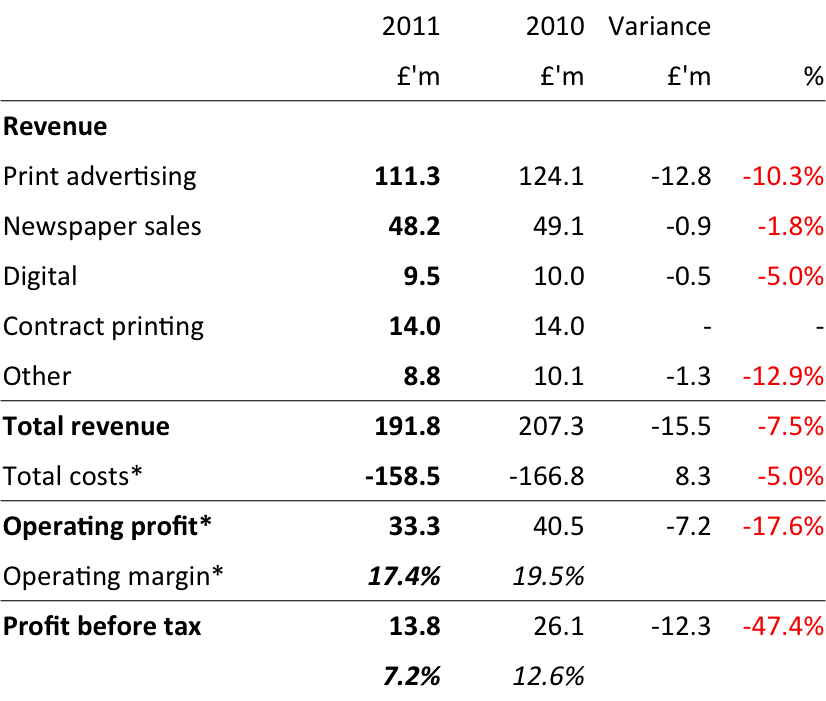
  • Total revenue down 7.5% to £191.8m
  • Total advertising revenues decreased by 10.0% year on year, with employment revenues continuing to contribute most to the decline in print and digital, but offset by growth in national display advertising
  • Circulation revenues down just 1.8% on the first half of 2010
  • Digital revenues down 5.0%, but with an improving trend from -9.7% in Q1 to -1.5% year on year in Q2, reflecting the benefit of the launch of the Find it business directory in March 2011
  • Total costs for the first 26 weeks of 2011 were reduced by £8.3m compared with the same period in 2010, despite a £4.2m impact of newsprint prices

Group debt

  • Net debt is £370.7m. A reduction of £16.0m since the start of the year
  • Facility reduction of £20.0m scheduled for 30 June 2012 was brought forward to 30 April 2011 by the Group

 Other news

  • Two new digital partnerships with Zoopla for online property and Nimble Commerce for online vouchers
  • New Chief Executive Officer, Ashley Highfield, is to join the Group on 1 November 2011

Commenting on the results, John Fry, Chief Executive Officer of Johnston Press plc said:

“The Group achieved an operating profit before non-recurring items of £33.3m despite the challenging UK economic environment of the first half of 2011, down 17.6% on the first half of 2010. This was achieved by tight operational control, with further cost reductions of £8.3m resulting from new processes and an increased centralisation of back office functions. Operating cash flow within the Group remains strong, with a further debt reduction of £16.0m achieved in the first half of 2011.

We remain cautious about the advertising outlook for the second half of the year, with total advertising revenues in the first seven weeks down 8.1%. Digital revenues, which returned to year-on-year growth in May, have continued to grow in the second half with the first seven weeks up 6.8% compared to the same period in 2010. We are also delighted to be able to announce the new digital partnerships with Zoopla and Nimble which will enable a significant enhancement of our property website and the launch of a new online vouchers business in the autumn. The Board has confidence that, in the absence of a further significant deterioration in the UK economy, the outcome for the Group in 2011 will be broadly in line with current expectations.”

Google announces Q1 financial results

Google Inc. has announced financial results for the quarter ended March 31, 2011.

The announcement follows below.

Q1 Financial Summary

Google reported revenues of $8.58 billion for the quarter ended March 31, 2011, an increase of 27% compared to the first quarter of 2010. Google reports its revenues, consistent with GAAP, on a gross basis without deducting traffic acquisition costs (TAC). In the first quarter of 2011, TAC totaled $2.04 billion, or 25% of advertising revenues.

Google reports operating income, operating margin, net income, and earnings per share (EPS) on a GAAP and non-GAAP basis. The non-GAAP measures, as well as free cash flow, an alternative non-GAAP measure of liquidity, are described below and are reconciled to the corresponding GAAP measures in the accompanying financial tables.

  • GAAP operating income in the first quarter of 2011 was $2.30 billion, or 27% of revenues [updated from $2.80 billion, or 33% of revenues]. This compares to GAAP operating income of $2.49 billion, or 37% of revenues, in the first quarter of 2010. Non-GAAP operating income in the first quarter of 2011 was $3.23 billion, or 38% of revenues. This compares to non-GAAP operating income of $2.78 billion, or 41% of revenues, in the first quarter of 2010.
  • GAAP net income in the first quarter of 2011 was $1.80 billion [updated from $2.30 billion], compared to $1.96 billion in the first quarter of 2010. Non-GAAP net income in the first quarter of 2011 was $2.64 billion, compared to $2.18 billion in the first quarter of 2010.
  • GAAP EPS in the first quarter of 2011 was $5.51 [updated from $7.04] on 326 million diluted shares outstanding, compared to $6.06 in the first quarter of 2010 on 323 million diluted shares outstanding. Non-GAAP EPS in the first quarter of 2011 was $8.08, compared to $6.76 in the first quarter of 2010.
  • Non-GAAP operating income and non-GAAP operating margin exclude the expenses related to stock-based compensation (SBC), and in the first quarter of 2011, the charge related to potential resolution of Department of Justice investigation. Non-GAAP net income and non-GAAP EPS exclude the expenses related to SBC and the charge related to potential resolution of Department of Justice investigation, and the related tax benefits. In the first quarter of 2011, the charge related to SBC was $432 million, compared to $291 million in the first quarter of 2010. The tax benefit related to SBC was $92 million in the first quarter of 2011 and $65 million in the first quarter of 2010. The charge related to potential resolution of Department of Justice investigation was $500 million. We recognized no tax benefit for the charge related to potential resolution of Department of Justice investigation.

Q1 Financial Highlights

Revenues – Google reported revenues of $8.58 billion in the first quarter of 2011, representing a 27% increase over first quarter 2010 revenues of $6.77 billion. Google reports its revenues, consistent with GAAP, on a gross basis without deducting TAC.

Google Sites Revenues – Google-owned sites generated revenues of $5.88 billion, or 69% of total revenues, in the first quarter of 2011. This represents a 32% increase over first quarter 2010 revenues of $4.44 billion.

Google Network Revenues – Google’s partner sites generated revenues, through AdSense programs, of $2.43 billion, or 28% of total revenues, in the first quarter of 2011. This represents a 19% increase from first quarter 2010 network revenues of $2.04 billion.

International Revenues – Revenues from outside of the United States totaled $4.57 billion, representing 53% of total revenues in the first quarter of 2011, compared to 52% in the fourth quarter of 2010 and 53% in the first quarter of 2010. Excluding gains related to our foreign exchange risk management program, had foreign exchange rates remained constant from the fourth quarter of 2010 through the first quarter of 2011, our revenues in the first quarter of 2011 would have been $19 million lower. Excluding gains related to our foreign exchange risk management program, had foreign exchange rates remained constant from the first quarter of 2010 through the first quarter of 2011, our revenues in the first quarter of 2011 would have been $23 million lower.

  • Revenues from the United Kingdom totaled $969 million, representing 11% of revenues in the first quarter of 2011, compared to 13% in the first quarter of 2010.
  • In the first quarter of 2011, we recognized a benefit of $14 million to revenues through our foreign exchange risk management program, compared to a benefit of $10 million in the first quarter of 2010.

Paid Clicks – Aggregate paid clicks, which include clicks related to ads served on Google sites and the sites of our AdSense partners, increased approximately 18% over the first quarter of 2010 and increased approximately 4% over the fourth quarter of 2010.

Cost-Per-Click – Average cost-per-click, which includes clicks related to ads served on Google sites and the sites of our AdSense partners, increased approximately 8% over the first quarter of 2010 and decreased approximately 1% over the fourth quarter of 2010.

TAC – Traffic Acquisition Costs, the portion of revenues shared with Google’s partners, increased to $2.04 billion in the first quarter of 2011, compared to TAC of $1.71 billion in the first quarter of 2010. TAC as a percentage of advertising revenues was 25% in the first quarter of 2011, compared to 26% in the first quarter of 2010.

The majority of TAC is related to amounts ultimately paid to our AdSense partners, which totaled $1.70 billion in the first quarter of 2011. TAC also includes amounts ultimately paid to certain distribution partners and others who direct traffic to our website, which totaled $337 million in the first quarter of 2011.

Other Cost of Revenues – Other cost of revenues, which is comprised primarily of data center operational expenses, amortization of intangible assets, content acquisition costs as well as credit card processing charges, increased to $897 million, or 10% of revenues, in the first quarter of 2011, compared to $741 million, or 11% of revenues, in the first quarter of 2010.

Operating Expenses – Operating expenses, other than cost of revenues, were $3.34 billion [updated from $2.84 billion] in the first quarter of 2011, or 39% of revenues [updated from 33% of revenues], compared to $1.84 billion in the first quarter of 2010, or 27% of revenues.

SBC – In the first quarter of 2011, the total charge related to SBC was $432 million, compared to $291 million in the first quarter of 2010.

We currently estimate SBC charges for grants to employees prior to April 1, 2011 to be approximately $1.7 billion for 2011. This estimate does not include expenses to be recognized related to employee stock awards that are granted after March 31, 2011 or non-employee stock awards that have been or may be granted.

Operating Income – – GAAP operating income in the first quarter of 2011 was $2.30 billion, or 27% of revenues [updated from $2.80 billion, or 33% of revenues]. This compares to GAAP operating income of $2.49 billion, or 37% of revenues, in the first quarter of 2010. Non-GAAP operating income in the first quarter of 2011 was $3.23 billion, or 38% of revenues. This compares to non-GAAP operating income of $2.78 billion, or 41% of revenues, in the first quarter of 2010.

Interest and Other Income, Net – Interest and other income, net increased to $96 million in the first quarter of 2011, compared to $18 million in the first quarter of 2010.

Income Taxes – Our effective tax rate was 25% [updated from 21%] for the first quarter of 2011.

Net Income – GAAP net income in the first quarter of 2011 was $1.80 billion [updated from $2.30 billion], compared to $1.96 billion in the first quarter of 2010. Non-GAAP net income in the first quarter of 2011was $2.64 billion, compared to $2.18 billion in the first quarter of 2010. GAAP EPS in the first quarter of 2011 was $5.51 [updated from $7.04] on 326 million diluted shares outstanding, compared to $6.06 in the first quarter of 2010 on 323 million diluted shares outstanding. Non-GAAP EPS in the first quarter of 2011 was $8.08, compared to $6.76 in the first quarter of 2010.

Cash Flow and Capital Expenditures – Net cash provided by operating activities in the first quarter of 2011 totaled $3.17 billion, compared to $2.58 billion in the first quarter of 2010. In the first quarter of 2011, capital expenditures were $890 million, the majority of which was related to IT infrastructure investments, including data centers, servers, and networking equipment. Free cash flow, an alternative non-GAAP measure of liquidity, is defined as net cash provided by operating activities less capital expenditures. In the first quarter of 2011, free cash flow was $2.28 billion.

We expect to continue to make significant capital expenditures.

A reconciliation of free cash flow to net cash provided by operating activities, the GAAP measure of liquidity, is included at the end of this release.

Cash – As of March 31, 2011, cash, cash equivalents, and marketable securities were $36.7 billion.

Headcount – On a worldwide basis, Google employed 26,316 full-time employees as of March 31, 2011, up from 24,400 full-time employees as of December 31, 2010.

USA, Mountain View, CA

Related articles:

Centaur Media plc reports profits at top end of expectations

Centaur Media plc, the business information and events group, has issued a pre-close trading statement for the financial year ended 30 June 2011.  The Group expects to report profits at the top end of the Board’s expectations, with reported revenues 14% ahead of the prior year and EBITDA margins increased from 11% to 14%. Underlying FY11 revenues, excluding the impact of acquisitions and adjusting for the phasing of exhibitions, are 10% ahead.

Trading

Digital advertising revenues continued to show stronger growth than print, with H2 revenues 21% ahead of the same period last year. Print advertising revenues grew by 7% in H2. Total advertising revenues, on both a reported and underlying basis, grew by 14% year on year.

Total reported paid for content revenues grew by 7% in H2, with Perfect Information increasing its digital revenues by 8% over the same period. Underlying total paid for content revenues are only marginally up year on year reflecting continuing weakness across the consumer publishing titles.

Events revenues continue to show steady growth, with reported H2 revenues 20% ahead of the same period last year. Underlying year on year revenue growth across the events portfolio was 13%.  Marketing Week Live reported record visitor numbers and revenues 26% ahead of last year. Forward bookings across the Group’s exhibitions portfolio are showing strong growth compared to the same time last year.

Impact of the restructuring

As recently reported on Fusion DigiNet, the Group has restructured into three operating divisions, the senior management team is being strengthened, operations within Business Publishing are being rationalised and a number of non-core assets have been targeted for disposal.

The Group anticipates that the annualised cost savings related to these initiatives will exceed £1.5m with an associated exceptional cash charge in FY11, principally related to redundancy costs, of approximately £2.5m. There will also be a significant non-cash impairment charge in relation to the write down of assets affected by the restructuring. The restructuring will have no impact on the Group’s underlying performance for the year to 30 June 2011.

The rationalisation of Business Publishing and disposal of non-core assets will reduce pro-forma FY11 revenues by approximately £7m. These assets made a small profit contribution to the Group in FY11.

The restructuring is designed to enable the Group to focus in the short and medium term on a portfolio of higher growth and higher margin assets.

The Group is targeting EBITDA margins of 20% within the next 12-18 months, driven by the further investment across new products and digital platforms within the new operational structure and benefiting from the cost saving and rationalisation initiatives announced on 28 June.

Reporting segments

As a consequence of the restructure of the business into three main operating divisions: Business Publishing, Business Information and Exhibitions, the Group will be adopting a new segmental reporting structure in the FY11 preliminary results that reflects the way the business is now managed.

Cash flow and balance sheet

The Group continues to maintain a strong balance sheet, with high levels of cash generation in the second half of the year.   After taking into account the cash outflow related to the FEM acquisition announced in April 2011, the Group will report net cash at 30 June 2011 of approximately £2m.

The Group has an existing credit facility with The Royal Bank of Scotland, which has been recently increased from £5m to £8m and extended to October 2012. In addition to providing adequate headroom for the Group’s working capital requirements, the increase in the facility will provide additional capacity to finance bolt on acquisitions.

The Group expects to publish its full year results on 15 September 2011.

Geoff Wilmot, Chief Executive, commented

“The last quarter of the year, which is normally our strongest, ended at the top end of our expectations.  The improved trading conditions experienced in FY11 have continued into the current financial year. The recently announced restructuring and rationalisation, our portfolio of market leading brands and our strengthened management team, will enable Centaur to benefit more rapidly from continuing recovery and from the recent investments in digital services.  This will provide a robust platform from which to deliver accelerated revenue growth and margin improvement in the medium term.”

UK, London

Related articles: